Martha: More Than Just a First Name

The name “Martha” surfaces in the bible as being the name of Mary Magdalene’s and Lazarus’ sister. As mentioned in my blog No. 85, the name Maria (Mirjam) was seen as a title of high honor during the peak of Qumram. During that time, women with this name held high spiritual appointments within the religious communities. For example, these women were trained in the art of healing or lead liturgic ceremonies for women.

The name “Martha” has also a deeper meaning and actually presented a title. Martha means “mistress” and in contrast to women who were named Maria, a woman named Martha was allowed to possess property. Within their religious communities, both occupied the same status.

On our journey through Provence we also visited Tarascon, the place where Martha once lived. As legend has it, Martha freed that place from a monster named “Tarasque” and the inhabitants honored her for her brave deed. On paintings and depictions of Martha throughout that region of Provence, one can see her portrayed with a dragon and a mallet with which she supposedly killed the monster. The church of Tarascon is one big memorial site, full with pictures of her. Our tour group had also view this church on our spiritual journey through Provence in the fall.

Mary Magdalene

Mary Magdalene – A Prostitute?

In 1896 a papyrus codex from the 5th century was found in Kairo. It contained the gospel of Mary Magdalene. Interestingly, it is not a gospel by Mary Magdalene, but about her. Well known religious scholars, among them Karen L. King of Harvard Divinity School (USA), have translated the document. It offers a fascinating insight into the origins of Christianity and allows for a new view of Jesus’ doctrines as a way to receive spiritual knowledge. And it shows that the common misconception that Mary Magdalene was a prostitute is nothing more than theological fiction.

How did it happen that the Roman Catholic church “misunderstood” Mary Magdalene to be a prostitute. Who came up with this rumor? One could suspect that the composer of the gospel of Luke misunderstood the original story of Jesus’ anointment by Mary Magdalene as the “woman with the alabaster jar”, because it was written down 50 years later. Because this anointment was similar to a widely known custom, that was carried out by holy priestesses or the goddesses’ “temple prostitutes” in the Roman Empire. The correct description for these priestesses was “Hierodulae” or “Holy Women”, not “prostitute”.

During my travels through Provence I stumbled upon many depictions of Mary Magdalene with the alabaster jar. The photos posted below were taken in the cathedrale of Aix-en-Provence, which I visited with my tour group during the spiritual trip in the fall of this year.

Mary Magdalene

In the Footsteps of Mary Magdalene: St. Maximin – Mary Magdalene Grotto – St. Maximin-la-Sainte-Baume

“Today’s visit to the Mary Magdalene grotto was surely one of the absolute highlights of our spiritual journey. The weather angel looked out for us as it was supposed to rain, but didn’t. We arrived in Plan d-Aups and walked through a mystic forest, that supposedly consists of trees up to 1000 years old, to the grotto. Numerous kinds, aristocrats and popes walked on this path in the past centuries, because La Baume („The cave“) has been a well-known pilgrimage place since the 5th century. On the walk to the grotto, one also passes a larger-than-life cruxification-scene, which looks quite spectacular.

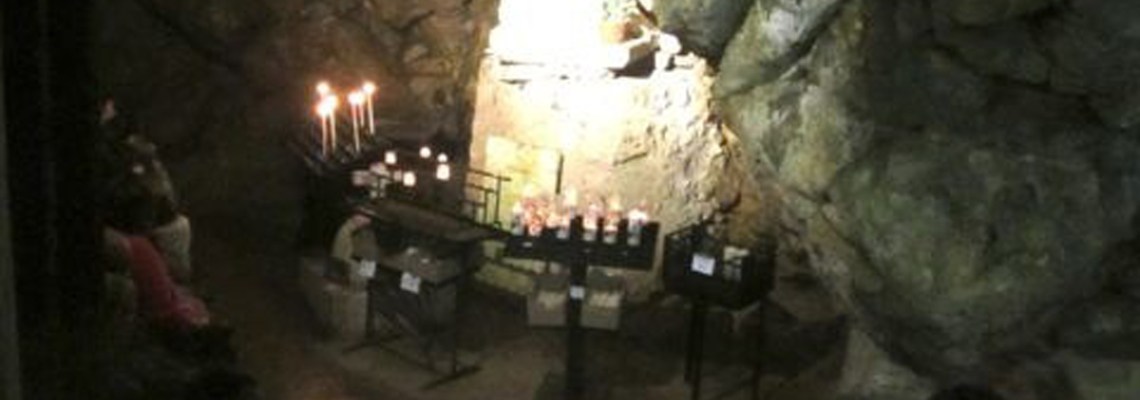
Standing at the entrance to the grotto, one has an amazing view of scenery of Eastern Provence, a region most commonly associated with Saint Maximin. As legend has it, Mary Magdalene lived in the cave for 30 years, to atone for her sins. The interior of the grotto houses two memorial sites as well as beautiful glass windows which depict scenes of Mary Magdalene’s life. Many of us could feel her energy and were touched by it.

After leaving the cave we drove to the basilica in Saint-Maximin-la-Sainte-Baum, which is dedicated to Mary Magdalene and Maximinus who are depicted by the main entrance of the church. The church is one huge commemoration site and depicts Mary Magdalene in various ways through paintings, sculptures, at the altar on carved or painted medallions. Especially noteworthy ist he golden ‚rose altar’ that depicts a view scenes of Mary Magdalene’s life and the carved pulpit.

In the church crypt one can view a sarcophagus that supposedly houses the human remains of Mary Magdalene. In addition, her head is displayed in a glass container behind the iron bars of the altar. The glas container is decorated with a golden mask in front, which can be removed. The reliquary is being carried through town during its annual procession.

Today our spiritual journey is coming to an end and we are celebrating with an evening meditation and dinner. It was a particularly harmonic, intense and transformative time together, during which many new friendships developed and existing friendships were deepend. Each of the participants went through his/her own transformation process during the course of the journey and could proceed towards his/her own spiritual developmental path.

The last few days were very touching and moving for all of us, at the same time we had a lot of fun and laughed together. We enjoyed eachother’s company, the excellent French cuisine and the exquisite French wine. Spirituality has nothing to do with being detached or with askesis, but can take place during one’s life on earth.

PS: Tomorrow, Gerd and I are traveling to Languedoc in order to prepare our Spiritual Journey 2014. …”

France Spirituality & Journeys

Mary Magdalene and the 7 “Demons”

The gospel of Luke states that some of Jesus’ followers were women, “…and certain women who had been healed of evil spirits and infirmities: Mary that was called Magdalene, from whom seven demons had gone out” (Luke 8:2). At least, this is the official version of the Roman Catholic church which held up as the “truth” till the present.

It is interesting to know that the Essenes, which Jesus was a part of, used certain words as ciphering in order to prevent the Romans from understanding their messages and gospels. (The well known theologist Barbara Thiering from the University of Sydney wrote the most comprehensive study on this topic.) The Essenes used terms like “the blind” for those people who didn’t follow the “path”. The word “leprose” refers to people who weren’t born into a higher class or who were excluded from such a class. The “poor” were those members of the community who actually held high ranks, but who were required to give up all worldly possessions.

In this sense, the word “demons” cannot be understood literally either. The name Maria (Mirjam) was seen as a title of high honor during the peak of Qumram. During that time, women with this name held high spiritual appointments within the religious communities. For example, these women were trained in the art of healing or lead liturgic ceremonies for women. These women were bound to celibacy and understood the authority of the highest scribe. During the times of Mary Magdalene, the scribe was Judas Iskariot, who was described as the “seventh demon-priest”. Before Mary Magdalene got married, Judas released her from celibacy and this is where the phrase “seven demons were cast out of her” came from. After that occurred she was allowed to have physical contact with her husband, but only according to strict rules. (See: Jesus the Man: New Interpretations from the Dead Sea Scrolls by Barbara Thiering, chapter 17) But I will tell you about that another time.

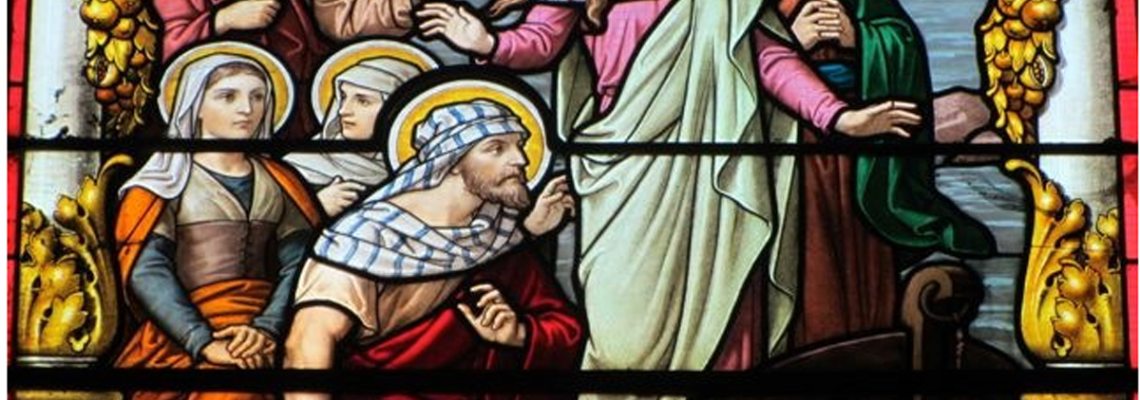
The pictures to this blog entry were all taken in Provence. The first photo shows a beautiful glass window, which depicts the arrival of Mary Magdalene, Martha, Lazarus, Maximinus, Maria Jakobaea and Maria Salome. I uploaded the other photos to depict the energy this lovely region emanates.

Mary Magdalene

The Adoration of the Feminine in Southern France

When you are traveling through Provence, you will see Mary Magdalene chapels quite frequently. There seems to exist a network of Mary Magdalene sanctuaries. However, this wasn’t always the case. If you think back to the Middle Ages, we associate a very dark time with it. Back then women didn’t have any rights (unfortunately, this fact still exists in various countries today), but instead were viewed as the property of their husbands or fathers. They weren’t allowed to participate in the public sphere and weren’t able to own any form of property. The only exceptions were the women in Southern France. They, just like their husbands, were able to inherit and own property. Already in the early beginnings of Christianity it was a custom to worship women in that region.

The region of Southern France was the center of a Mary Magdalene worship over the span of many centuries. Many chapels, wells and springs still carry her name to this day, but during the 12th century when the worshipping of Mary Magdalene was outlawed, some of these cult sites received new names. They were named “Notre Dame” and were dedicated to Mother Mary. Due to these events, the importance of Mary Magdalene was pushed to the background and was lost until recently, when it was unearthed again. It is time again! It is her time again!

Mary Magdalene

The Holy Grotto of Mary Magdalene

One of the highlights of our spiritual journey in the fall will be a visit to “La Sainte Baume”, the “holy cave” of Mary Magdalene. In order to plan our itinerary and to double-check the infrastructure, we drove to this precious place yesterday. We hiked through a beautiful old forest to the cave, which is situated in a steep rock wall.

Legend has it that Mary Magdalene lived there as a penitent for 30 years and was carried from time to time into the valley by angels. Since we don’t just want to believe this popular belief, we discussed, while hiking up to the cave, how someone would have even been able to survive there 2000 years ago. Mary Magdalene cannot be considered a “regular person”, but instead has to be viewed as a highly enlightened and spiritual figure one can assume that she didn’t just feed off of food, but probably also knew the art of bilocation. She would have been able to feed off of light and could have existed in two locations at the same time.

Many royals and popes, who went to the cave to honor Mary Magdalene or to ask for her help and advice, also used the way we went over the lasthundreds of years. The scenic view from the entrance of the cave makes the long hike worth it and because of the wonderful atmosphere in the cave one can almost feel a holy energy. Even though our approach to Mary Magdalene probably differs from the other people who were praying in the grotto we felt a silent connection with them, as if a soft veil of energy enveloped us all.

Mary Magdalene

The Thing About the Truth…

As a child, I grew up in an environment where the teachings of the Roman Catholic Church was the only truth. Since then I freed myself from this misbelief. Even the immediate successors of Jesus – namely his apostles – were arguing amongst each other when it came to the authentic transmission of his teachings. Back then the church came up with different versions, which led to grim power struggles between the different fractions. Between 66 and 74 AD the Christian community in Jerusalem dissolved, and with it a binding version of Christianity. Some of the successors of this community, the Ebionites, were treated as heretics and turncoats and killed.

In the first four centuries chaos and prosecution of believers defined the history of the church. In 325 AD, in order to gain uniformity, the Council of Nicaea determined that Jesus was the native son of God. Everything the council decided on and defined as the truth had to be viewed by Christians as the only true beliefs and deviations were not accepted. (This dogmatic belief is still present today and comes through in the so-called infallibility of the pope.)

Other versions of the Christian teachings, which derived from the decided beliefs, were fought and their spread was prevented. Because of this there still exist many gospels from the first centuries that are not known to people, because the Roman church did not acknowledge them, e.g. the Maria Magdalene gospel from the 4th century.

Having said that, it should not come as a surprise that the teachings of Mary Magdalene, which were practiced and passed on from generation to generation by believers in France until the 12th century, are nowadays viewed as devil’s work, blasphemy or seen as fantasies of crazy mystics. Thousands of people paid with their lives in the Middle Ages, because they believed that Mary Magdalene was Jesus’ wife and passed on her intellectual heritage to her successors. Thankfully, we do not land on the stake for our belief today – at least not physically. 😉

In the small village church of Roussillon in Provence, I found Mary Magdalene and Jesus depicted next to each other. If you travel around with open eyes, you can still find hidden clues that point to their close connection. On our spiritual journey in the fall I will certainly visit this church with my group.

Mary Magdalene

The Holy Grail

I brought two very interesting books with me for my travels through Provence. Both depict the historical background surrounding Mary Magdalene and I highly recommend taking a look at them: Margaret Starbird’s “The Woman with the Alabaster Jar: Mary Magdalen and the Holy Grail” and Laurence Gardner’s ““Bloodline of The Holy Grail: The Hidden Lineage of Jesus Revealed” (1996) / “The Grail Enigma: The Hidden Heirs of Jesus and Mary Magdalene” (2008).

Various legends surround the Holy Grail. One of them states that Joseph of Arimathaea caught the dying Jesus’ blood in a cup and brought it on a ship to France. Since then, this treasure is missing and people have been looking for it for the past centuries. Especially in southern France many treasure hunters who are hoping to find the Holy Grail are searching the region around Rennes-le-Chaetau.

Have you ever thought about the possibility that the term “Holy Grail”, the cup with Jesus’ blood, should not be translated literally, but receives its true meaning figuratively? If that is the case, then it is the womb of Mary Magdalene, the renounced wife of Jesus. It would describe the holy vessel that carried his “blood”, namely his descendants, e.g. their daughter Sarah Tamar. The internationally renowned British historian and genealogist Laurence Gardner, who I mentioned earlier, argues that two more children were born to Mary Magdalene and Jesus, their sons Jesus Justus and Joseph. All three children are regarded as the founders of the greatest European royal lineages. (The pictures I have taken in Paris, Mallorca, and Barcelona)

Mary Magdalene

Black Madonna

We have been in Marseille in order to check everything on site for our Spiritual Journey this fall. Among other sights, we will visit with our group the church of St. Victor in Marseille, whose first bishop Lazarus was Mary Magdalene’s brother. In its crypt one can view a portrait of him that is etched into the stone, as well as a relief of his sister Mary Magdalene.

A distinctive feature of the crypt is certainly the black Madonna, who, in my opinion, depicts Mary Magdalene. In his book “Bloodline of The Holy Grail: The Hidden Lineage of Jesus Revealed” (1996) / “The Grail Enigma: The Hidden Heirs of Jesus and Mary Magdalene” (2008), Laurence Gardner states that the black Madonna had her roots in the goddess Isis and the pre-patriarchal Lilith. She presents the strength and equality of womanhood – a proud and assertive figure – which is a stark contrast to the obedient figure of the conventional white Madonna, portrayed in churches as the mother of Jesus.

Further, the author notes the following: “The women of the Dan lineage were Lay-Nazarenes. Mary Magdalene functioned as ‘Mirjam’ as the leader of the congregation and therefore was allowed to wear a black robe like the ones worn by the Nazarenes and the priestesses of Idis. Around the year 33 AD as part of the early worshipping of Mary, a cultic worshipping of the ‘black Madonna’ spread as well, which had its origin in the region of Ferrieres [France] (Ullstein Taschenbuchausgabe, page 131).

Mary Magdalene

Mother or Wife?

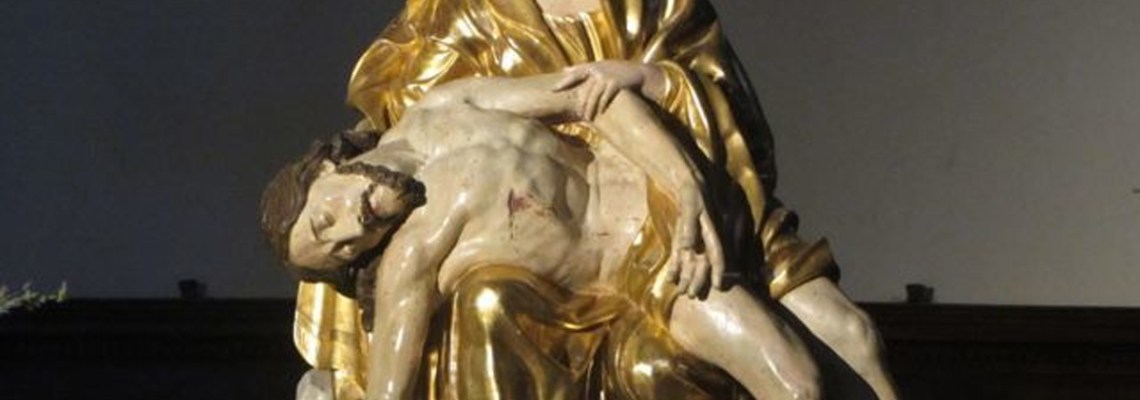
Have you ever thought about the fact that, no matter which artistic realization of a pieta one looks at, Mother Mary and Jesus are portrayed close in age? Do artists not value mothers or older women and instead want to portray younger women? Do those sculptures possibly portray Jesus’ wife Mary Magdalene instead of his mother? Did the artists back in the day know the truth about Mary Magdalene’s role in his life and pass on the information to their students? Or did the younger artists never question who they were portraying in actuality?

On my travels through Provence, I often ask myself these questions, knowing that Mary Magdalene was worshipped as the wife of Jesus throughout southern France for 1200 years. The roman church was clearly not thrilled by this and tried to fight this belief. The knowledge of Jesus’ marriage and his bloodline seemed too dangerous and the church made sure that the believers would worship his mother instead of his wife. Because of that reason, all the memorials dedicated to Mary Magdalene were transformed into places of worship for Mary, e.g. the Notre-Dame churches in France and Central Europe.

Mary Magdalene